





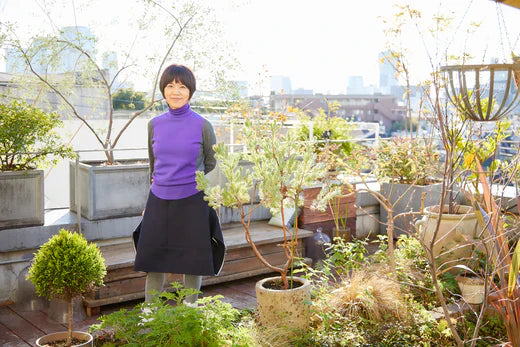
04. Miho Matsuura, Owner and Hair Stylist of TWIGGY.
Please tell us what inspired you to become a hairstylist.
Matsuura: My mother, who ran a hair salon, was the key person. I grew up as the third daughter in a small town hair salon. The greengrocer's aunt would come in, get a cut, and leave looking beautiful and very happy. People would gather around and say things like, "You look lovely" or "Your new hairstyle is great." I loved those conversations. Just one person becoming beautiful made everyone around them happy, and seeing everyone sparkle felt really good. This childhood feeling, combined with watching a movie based on the Swinging London culture of the 60s when I was around 18 or 19 and gaining a sense of self, made me want to express the difference between everyday beauty and the beauty I sought. That's how I decided to become a hairstylist.

Please tell us how you came to study abroad in London.
Matsuura: It was the 80s, and back then, after work, I'd just play around. I'd drink and dance until morning, then go to the hair salon where I worked without sleeping and shampoo hair, chuckles. Every day was fun and exciting, but I was in my mid-twenties and felt a dilemma that I wasn't becoming the ideal me at all. Then, I had the opportunity to go to London for the first time for a photoshoot. The gray cloudy sky, the brick buildings, the red double-decker buses and post boxes scattered around, somehow felt like my hometown image, like a rural townscape, which oddly put me at ease. I had moved from Fukuoka to Tokyo and was living there, but I felt a strange sense of home in London, even though it was my first time visiting. At that moment, I instinctively thought, "I'm going to live here," and decided to go to London. My life completely changed after that.
What was your two years in London like?
Matsuura: I'd like to give a more positive answer like "I studied hair," chuckles, but actually, I had a child and enjoyed life in London, chuckles. Of course, I was working too. But my pregnancy was a turning point. My close friend Nadia, whom I made in London, taught me about an organic lifestyle, including herbal teas, herbal oils, flower remedies, and homeopathy. At first, I thought, "What is this?" But the more she explained, the more interesting it became, and the deeper I delved, the more enjoyable it was. I felt like it might be beneficial to embrace this as a lifestyle, and I had a sense of personal growth.

Please tell us how you returned from the UK and opened TWIGGY.
Matsuura: Ultimately, my visa expired, and I reluctantly returned to Japan, full of lingering regret, chuckles. Nevertheless, I wanted to showcase the experiences I gained in London, so I opened TWIGGY. in a very small apartment room in Mita, Minato-ku, as it was close to my home and near a nursery school. I was running the salon alone, but I still wanted to do photoshoot work, backstage for shows, and express myself more. Imagining fun things and wanting to make them happen, I gradually increased my staff, and before I knew it, I had over 40 staff members, chuckles. It was far more enjoyable than working alone, and running a salon by myself wasn't leading to my dreams at all.
In 2011, you launched the hair care brand YUMEDREAMING, which focuses on the human body's natural healing power. Please tell us about the background of this.
Matsuura: The catalyst was when I accepted the position of artistic director for AVEDA, an American organic brand, for five years starting in 2003. I was able to be involved not only in proposing hairstyles but also in product development, and thanks to that experience, I came to want to create my own products. At the time, there were organic products, but there weren't any hair care brands that thoroughly considered hair, scalp, blood, and cells, so I felt I had to create one. Japanese hair quality is beautiful, lustrous, and uniquely like delicate porcelain, so I was particular about using domestically produced, pesticide-free plant-derived ingredients, studied science, and worked with dermatologists and researchers over many years to develop products that suit Japanese hair and blood.

What kind of place is TWIGGY. for you?
Matsuura: If fun things are happening in this salon, then that's good enough, and I think it's fine for its form to change constantly. Now, it feels like a salon where each staff member expresses their individuality, and everyone works together. I believe TWIGGY. is the crystallization of satisfaction—where I am satisfied, the staff are satisfied, and the customers are satisfied.
What is the appeal and true pleasure of being a hairstylist?
Matsuura: Cutting hair is my calling, and even now, it brings me immense joy. The true pleasure, I suppose, is being able to share happiness with people and deepen trust through expressing myself via cutting. The human connections that emerge from the act of cutting hair are what bring me joy.

How many hours do you usually sleep?
Please also share any routines you have before bed and after waking up.
Matsuura: I try to sleep at least 7 hours. It's a habit to do a short meditation for about 1 to 5 minutes before sleeping, and after dinner, I've been drinking something with warming ginger and spices for many years. In winter, it's always Samahan tea. It makes my throat feel a little scratchy, but then a pleasant drowsiness washes over me, and I just want to drift off to sleep. When I wake up in the morning, I first drink a glass of room-temperature or lukewarm plain hot water, wait about 15 minutes, then drink aojiru (green juice) to get enzymes. After that, I try to leave my stomach empty for about 30 minutes before eating breakfast.
You're using the gugu mattress, how do you find its comfort?
Matsuura: I'm sleeping very well. Coincidentally, around the time I switched to the gugu mattress, a friend gave me a double-structured pillow for my birthday, with thick and thin down feathers. When I rest my head on the pillow, it sinks in deeply, making my head and body flat, and I feel enveloped by the mattress. The mattress and that pillow are a great match, making it incredibly comfortable to sleep on.

How do you spend your days off to relax and refresh yourself?
Matsuura: Since I have a dog, my days off usually end with a walk. The parks are quite abundant, and the relationship between the parks and residential areas is very good in terms of location. So, ever since I got a dog and started taking walks, I've grown to love the local scenery more and more.
How important do you consider sleep to be?
Matsuura: I believe it's as important as eating and exercising. Apart from work, sleep is what takes up the most time in a day. So, I always want to do things that promote good sleep, and if I can achieve at least one thing each day that I'm satisfied with, I think it will lead to good sleep.
Text & Edit:Kazuhiro Hasegawa(gugu sleep)Interview photos:Kazuhiko Tawara(magNese inc.)

What sleep means to me

TWIGGY. owner and hairstylist. After working as a hairstylist and hair & makeup artist, she moved to the UK in 1988. After returning to Japan, she opened the hair salon TWIGGY. She is active in a wide range of genres, including salon work, magazines, advertisements, and shows. She also develops the haircare products "YUMEDREAMING EPICUREAN" and "TWI," which focus on natural healing power.